
What Should You Look for in a Mobility Chair?
Choosing a mobility chair starts with a proper assessment. Learn how riser recliner and postural support chairs differ, and what a good supplier provides.

Last Updated: November 12, 2026
Quick Summary
You should look for a mobility chair that matches the user's primary need, whether standing assistance or sustained postural support, and is sized by measurement during an in-person assessment. Choose a supplier who assesses quickly, brings equipment to trial at home, and handles delivery, setup and training.
- A riser recliner suits standing assistance, while a postural support chair suits complex postural needs.
- Ask suppliers how fast they assess, what they bring to the trial and what documentation you receive.
- Seat width, depth and height must each suit the person's body, decided by measurement.
- Learn which handset button does what before the supplier leaves, and keep the handset within reach.
- Venneo attends on site within 48 hours and sends an itemised quote and full report within 24 hours.
Table of Contents
- Why a Mobility Chair Assessment Comes First
- Riser Recliner Chair or Postural Support Chair?
- What to Ask a Mobility Equipment Supplier
- Choosing the Right Size, Fit and Upholstery
- How to Use a Mobility Chair Safely
- Frequently Asked Questions
Why a Mobility Chair Assessment Comes First
A mobility chair assessment is a structured, in-person evaluation matching a person to seating they can use safely every day. At Venneo, our Venneo Velocity promise puts us on site within 48 hours, so discharge plans and care packages do not stall.

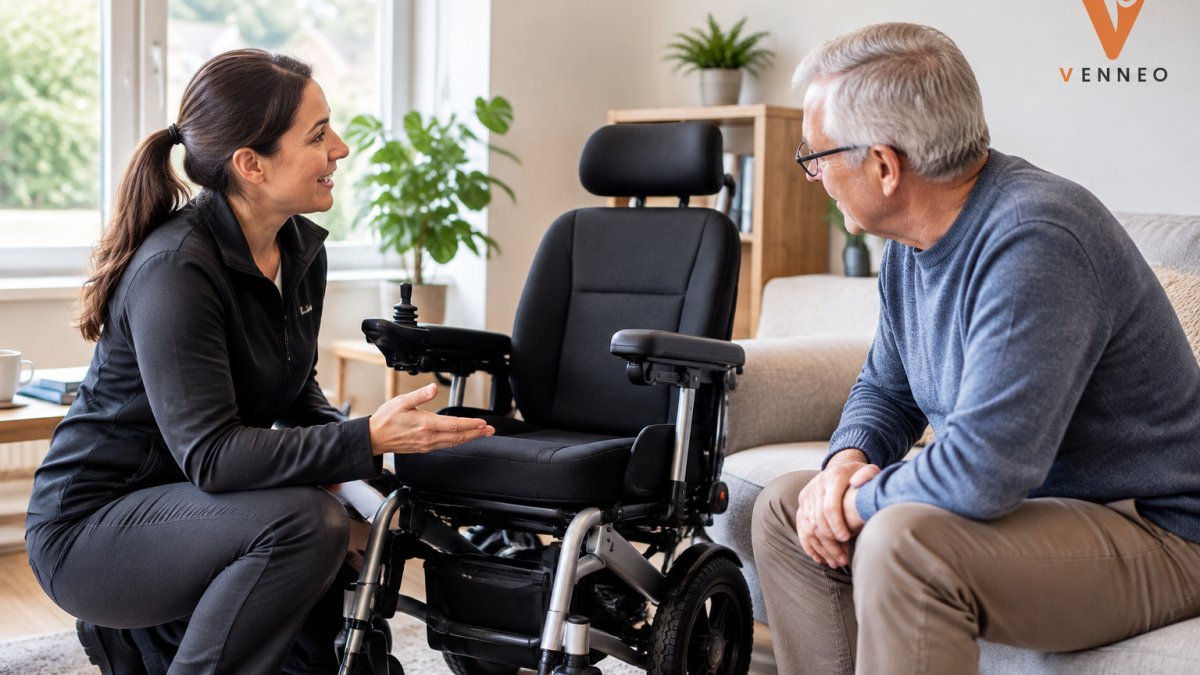
Seat height, depth, back angle and transfer method all interact, get one wrong and the person slides forward or cannot stand without help. The Royal College of Occupational Therapists is clear that seating decisions belong with a qualified assessor who can see the person in their own environment, so we bring equipment options to the home for a trial. You can book a free on-site equipment assessment and we will attend, measure the space and document what the client needs.
Riser Recliner Chair or Postural Support Chair?
The choice comes down to one question: is the primary need standing assistance, or sustained posture and pressure management? A riser recliner lifts and tilts the user towards standing; a postural support chair holds the pelvis and trunk in a controlled position for longer periods.
| Chair type | Best for | Key features | Watch for |
|---|---|---|---|
| Riser recliner | Standing assistance at home | Lift and tilt, handset control, battery backup | Check seat depth against leg length |
| Postural support chair | Complex postural needs | Contoured seating, lateral support, headrest adjustment | Needs a specialist assessment |
| Dual motor recliner | Independent back and leg angles | Separate backrest and legrest control | Higher cost than single motor |
What to Ask a Mobility Equipment Supplier
Ask any mobility equipment supplier four things before you commit: how fast they assess, what they bring to the trial, who handles delivery and setup, and what documentation you receive.
Speed is the first filter, a supplier who cannot attend quickly leaves discharge teams waiting. Our 48-hour on-site commitment is designed to keep discharge plans moving. Ask too about breadth: a single source supplier covering specialist seating, beds and positioning, access, mobility and bathing removes the juggling act. For a deeper look, read how one supplier can simplify your equipment assessment schedule.
Ask what happens after delivery, since equipment arriving without setup or training creates a new problem, we handle delivery, set-up and training, then call one week later. Finally, ask about paperwork: an itemised quote and full assessment report within 24 hours keeps funding approvals moving. We are a corporate associate of BABICM, the British Association of Brain Injury and Complex Case Management, which reflects our focus on complex caseloads.
Choosing the Right Size, Fit and Upholstery
Fit is decided by measurement during the assessment. Seat width, seat depth and seat height each need to suit the person's body, and weight capacity, lumbar support and headrest adjustment follow from that assessment.
Upholstery matters, and healthcare furniture and home settings may have different needs. Ask your supplier how the fabric is cleaned and whether covers are replaceable, and follow the manufacturer's cleaning guidance.
How to Use a Mobility Chair Safely
Learn which handset button does what before the supplier leaves, and keep the handset within reach when seated. Never stand on the footrest, never let anyone lean over a raised legrest, and keep the area around the chair clear.
Frequently Asked Questions
Do I need an assessment before choosing a mobility chair?
Yes. A mobility chair assessment checks seat height, width and depth, back and head support, and how the person transfers in and out. It also confirms which mechanism suits their needs. An on-site assessment lets the chair be trialled in the actual home or care setting, so fit and clearance are tested before purchase. Venneo aims to attend with you within 48 hours of enquiry, then sends an itemised quote and full assessment report within 24 hours of the visit.
What is the difference between a mobility chair and a riser recliner chair?
A mobility chair is the broad term for seating that supports movement, posture and standing. A riser recliner chair is one type: it tilts and lifts to help the user stand, and reclines for rest. A postural support chair is another type, built around orthopaedic seating and pressure relief for people who need sustained posture support. The right choice depends on the person's mobility, tone and transfer ability, which is why an assessment matters.
How do I know whether a mobility chair is the right size?
Fit is measured, not guessed. Seat width, seat depth and footplate position should each suit the person's body, and a proper assessment checks them. Weight capacity, back height and headrest adjustment all affect comfort. A home visit confirms the chair clears doorways and fits the room. Venneo brings equipment options to the client for trial, so sizing is checked in person.
 Add venneo.co.uk as a preferred source on Google →
Got a client you’re weighing options for? Send us the measurements and we’ll come back with what fits.