
How Do You Choose an Assistive Equipment Procurement Service?
Choosing an assistive equipment procurement service starts with clear criteria. Compare suppliers, assessment quality and rental options before you commit.

Last Updated: November 21, 2026
Quick Summary
Choose an assistive equipment procurement service by scoring providers on scope of supply, assessment expertise, written outputs and stated turnaround times, trials and fitting, training and support, accountability, and whole-life cost. Confirm the service covers every equipment category you need and issues an itemised quote and assessment report in writing.
- Venneo is on site within 48 hours for an assessment, with an itemised quote by email within 24 hours.
- A full assessment report follows within 24 hours of the visit.
- Ask for a stated turnaround in hours, not "shortly".
- Request a whole-life cost breakdown covering purchase, delivery, fitting, training, maintenance, replacement and disposal.
- Rental suits short-term or uncertain need; buying outright suits long-term use with one person.
Table of Contents
- What Should You Look for in an Assistive Equipment Procurement Service?
- Why the Right Assistive Equipment Supplier Changes the Outcome
- What a Thorough Occupational Therapy Equipment Assessment Includes
- When Specialist Equipment Rental Beats Buying Outright
- Frequently Asked Questions
What Should You Look for in an Assistive Equipment Procurement Service?
Choosing an assistive equipment procurement service starts with speed, documentation and clinical fit.
Most procurement guidance covers how to buy equipment, not how to compare the services doing the buying. Use this checklist to score providers side by side.
1. Scope of supply. Does one provider cover the equipment categories you need, or will you coordinate several suppliers and several invoices? A single point of contact reduces the handover gaps where discharges stall.
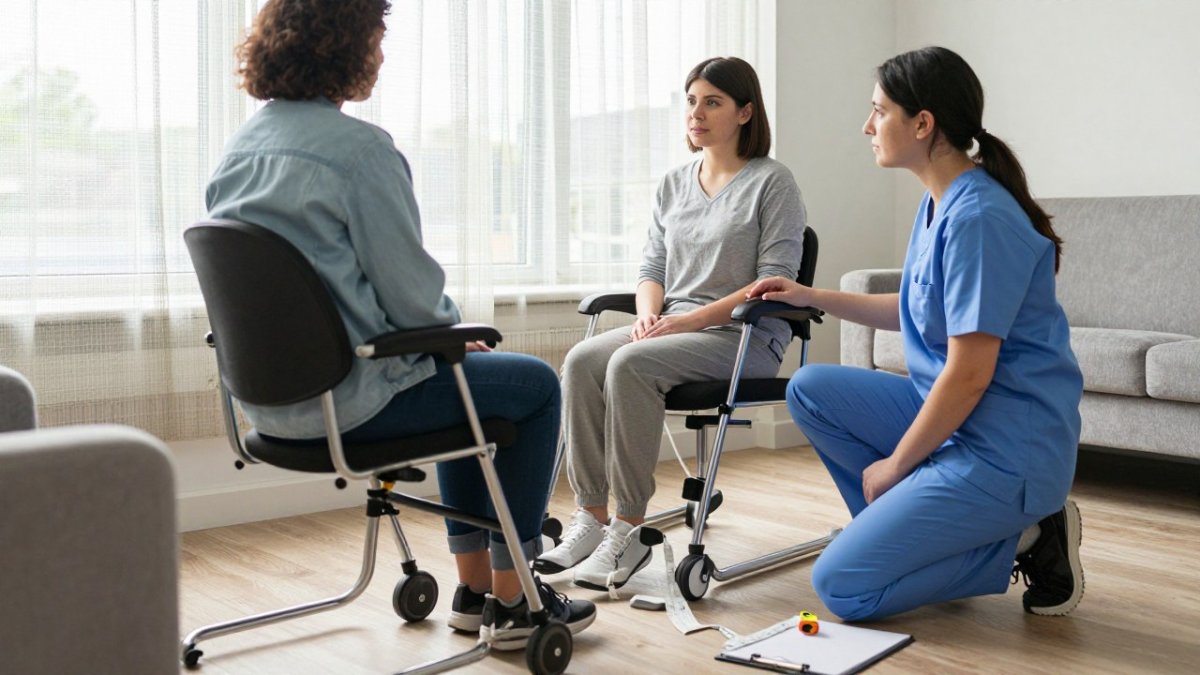
2. Assessment expertise. Ask who attends and what qualification they hold. A structured assessment records the client's needs, the home environment and the intended outcome, then matches all three to a specified product. A verbal recommendation with nothing on paper leaves case managers unable to evidence funding decisions.
3. Written outputs and timescales. Confirm what you receive and when: a written assessment report with full specification, a separate itemised quotation, and a named contact for follow-up. Ask for a stated turnaround in hours, not "shortly".
4. Trials and fitting. Can the client try before you commit, and who fits and adjusts the equipment on delivery? On-site trials and a named fitter separate equipment that is used from equipment that is stored.
5. Training and ongoing support. Ask what training is included for the client and their carers, what the repair response time is, and whether maintenance is bundled or charged separately.
6. Accountability and records. Confirm how the provider handles personal data collected during assessment, who owns the records, and how quickly they respond when something fails. Connected equipment may collect sensitive data, so ask about security and consent before you sign.
7. Whole-life cost. Request a breakdown covering purchase, delivery, fitting, training, maintenance, replacement and disposal, not just the headline price. A cheap initial quote with unbundled maintenance is rarely the lowest whole-life cost.
NHS England guidance on equipment and personal health budgets is a useful starting point for understanding how equipment decisions are funded and reviewed.
You can book a free on-site equipment assessment and see the 48-hour promise for yourself.
Score providers against these checks before you commit.
| Check | What to confirm |
|---|---|
| Scope of supply | One provider covers all the equipment categories you need |
| Assessment expertise | Who attends and what qualification they hold |
| Written outputs | Written assessment report, separate itemised quotation, named contact |
| Timescales | Stated turnaround in hours, not "shortly" |
| Trials and fitting | On-site trials and a named fitter on delivery |
| Training and support | Training for client and carers, repair response time, maintenance terms |
| Accountability and records | How personal data is handled, who owns records, response when something fails |
| Whole-life cost | Breakdown covering purchase, delivery, fitting, training, maintenance, replacement, disposal |
Why the Right Assistive Equipment Supplier Changes the Outcome
The right assistive equipment supplier shortens the gap between a clinical decision and a working piece of kit in someone's home. That gap is where discharges stall and caseloads back up.
We only recommend products we know will benefit the client. A common myth is that sales reps push whatever earns the most commission. Sadly, that is often true in the industry.
A good supplier asks questions first. What does the client need to do? Where will the equipment live? Who will adjust it?
Get those answers right and the equipment lasts. Get them wrong and you are replacing it within months.
What a Thorough Occupational Therapy Equipment Assessment Includes
An occupational therapy equipment assessment is a structured visit that records the client's needs, the environment and the intended outcome, then matches all three to a specified product.
At Venneo, the visit produces two documents within 24 hours: a full assessment report for the file, plus a separate itemised quote sent by email. You can see exactly what the assessment report covers before you book.
When Specialist Equipment Rental Beats Buying Outright
Specialist equipment rental wins when the need is short-term, the outcome is uncertain, or the client is moving between settings. Buying outright suits long-term use where the equipment stays with one person. The decision turns on four questions: how long is the need, how certain is the outcome, who maintains the kit, and what happens to it at the end.
Rental makes sense for:
- Post-surgery recovery with a known end date
- Trial periods before committing to a made-to-measure chair
- Respite and interim placements
- Clients whose needs may change as rehabilitation progresses
- Schools and smaller organisations that need equipment for a term rather than a decade
Buying outright makes sense when the equipment will stay with one person for years, when it is made to measure, and when the client or funder wants to own the asset outright.
What a rental agreement should set out. Ask for the rental period and notice terms, what happens if the need ends early, who handles delivery, fitting, collection, cleaning and repair, and the replacement policy if equipment fails. Confirm whether maintenance is included or charged separately, and get the whole-life cost in writing to compare with a purchase quote on equal terms.
The hidden costs of buying. Purchase price is only the first line: delivery, fitting, training, maintenance, replacement parts and disposal all add to the total. Rental bundles many of these into one recurring charge, keeping capital free and removing the storage and maintenance question, particularly useful for charities and smaller organisations that cannot hold stock between clients.
The hidden costs of rental. Rental is rarely cheaper for long-term need: cumulative charges will usually exceed the purchase price, and you may have less control over specification and replacement timing. Model both routes over the expected period of need before deciding.
How Venneo Rental fits. Venneo Rental is built for these short-term and uncertain cases, and pairs with our Velocity promise: on site within 48 hours for an assessment, with an itemised quote by email and a full assessment report within 24 hours of the visit.
Watch out: a rental agreement that does not state who collects the equipment and who pays for repairs can leave you holding a recurring charge for kit nobody is using.
If you are weighing it up, simplifying your equipment assessment schedule with one supplier makes the rental decision far easier to manage.
Procurement delays keep people in hospital beds longer than they need to be. Venneo exists to remove that delay: on-site assessment within 48 hours, itemised quotes and full reports within 24 hours, and one accountable partner across specialist seating, beds and positioning, access, mobility and bathing. Get started with Venneo and give your discharge team a supplier that moves at the speed of your caseload.
Frequently Asked Questions
What should I look for in an assistive equipment procurement service?
Look for clear response times, a documented assessment process, itemised quoting and a single point of accountability. Ask whether the provider attends in person, how quickly they report back, and whether they handle delivery, fitting and training. At Venneo, we attend within 48 hours and send an itemised quote and full assessment report within 24 hours of the visit, which keeps case files moving.
Can assistive equipment be rented instead of purchased?
Yes. Specialist equipment rental suits short-term rehabilitation, trial periods and changing needs, and it avoids tying up budget in kit a client may outgrow. Ask the provider how rental interacts with a later purchase, who handles maintenance and repairs, and what notice is needed to end the agreement.
What information should I provide when sourcing specialist equipment?
Give the provider the client's clinical picture, postural and mobility needs, the setting where the equipment will be used, and any access constraints such as doorway widths or floor surfaces. Share funding status and target dates. The more context you give, the more accurate the equipment assessment and the fewer rounds of revision. Venneo asks questions up front so the recommendation fits the person, not just the diagnosis.
 Add venneo.co.uk as a preferred source on Google →
Got a client you’re weighing options for? Send us the measurements and we’ll come back with what fits.